
When you think about what makes a humanitarian negotiator effective, technical knowledge often comes to mind: knowing the rules of international humanitarian law, understanding the political context, or having the right contacts.
But ask any experienced frontline negotiator what actually moves the needle in a difficult conversation, and the answer is almost always the same: people skills.
These are soft skills – the interpersonal abilities that shape how you communicate, build relationships, and navigate conflict. In humanitarian settings, where negotiations can mean the difference between aid reaching people in need or not, these skills become vital to the work.
At the CCHN, our approach to soft skills is grounded in neuroscience. Understanding what happens in the brain under stress, and how to work with it rather than against it, sits at the heart of our training.
Why soft skills matter in high-pressure negotiations
Humanitarian negotiations rarely happen in calm, controlled environments.
You are often working under time pressure, with limited information, in contexts marked by violence, fear, or deep mistrust. These conditions take a toll, not just emotionally, but neurologically too.
Here is what the science tells us: under normal circumstances, your brain’s frontal lobes handle reasoning, complex problem-solving, verbal communication, and abstract thinking.
But when you are under stress – when you feel threatened, overwhelmed, or unsafe – the brain shifts into survival mode. The limbic system, often called the “emotional brain,” takes over. Instinct overrides reasoning.
For a negotiator, this is a critical moment. When stress activates the limbic system, you may lose access to some of your most important capabilities: empathy, active listening, self-awareness, flexible thinking, and sound decision-making. The very skills you need most become harder to access.
And it is not just you. Your counterpart is likely facing the same dynamic; some might even use your stress response against you.
If both sides are operating from a place of threat and defence, the conversation can quickly spiral into emotional reactions rather than constructive dialogue.
This is why developing soft skills is not about learning a set of tricks or techniques. It is about building the capacity to stay grounded, connected, and clear-headed even when the pressure is on.
A framework rooted in neuroscience
The CCHN’s approach to soft skills draws, among others, on Bruce Perry’s neurosequential model, which describes how the brain develops and processes experience in a specific order.
Perry’s neurosequential model suggests that brain development occurs in a sequential and hierarchical manner, with the human brain being structured to receive particular stimuli during specific critical periods (Perry, 2006).
Applied to negotiation, this model suggests that effective communication follows a natural sequence: you must first build trust, then create a connection, and only then can you meaningfully influence.
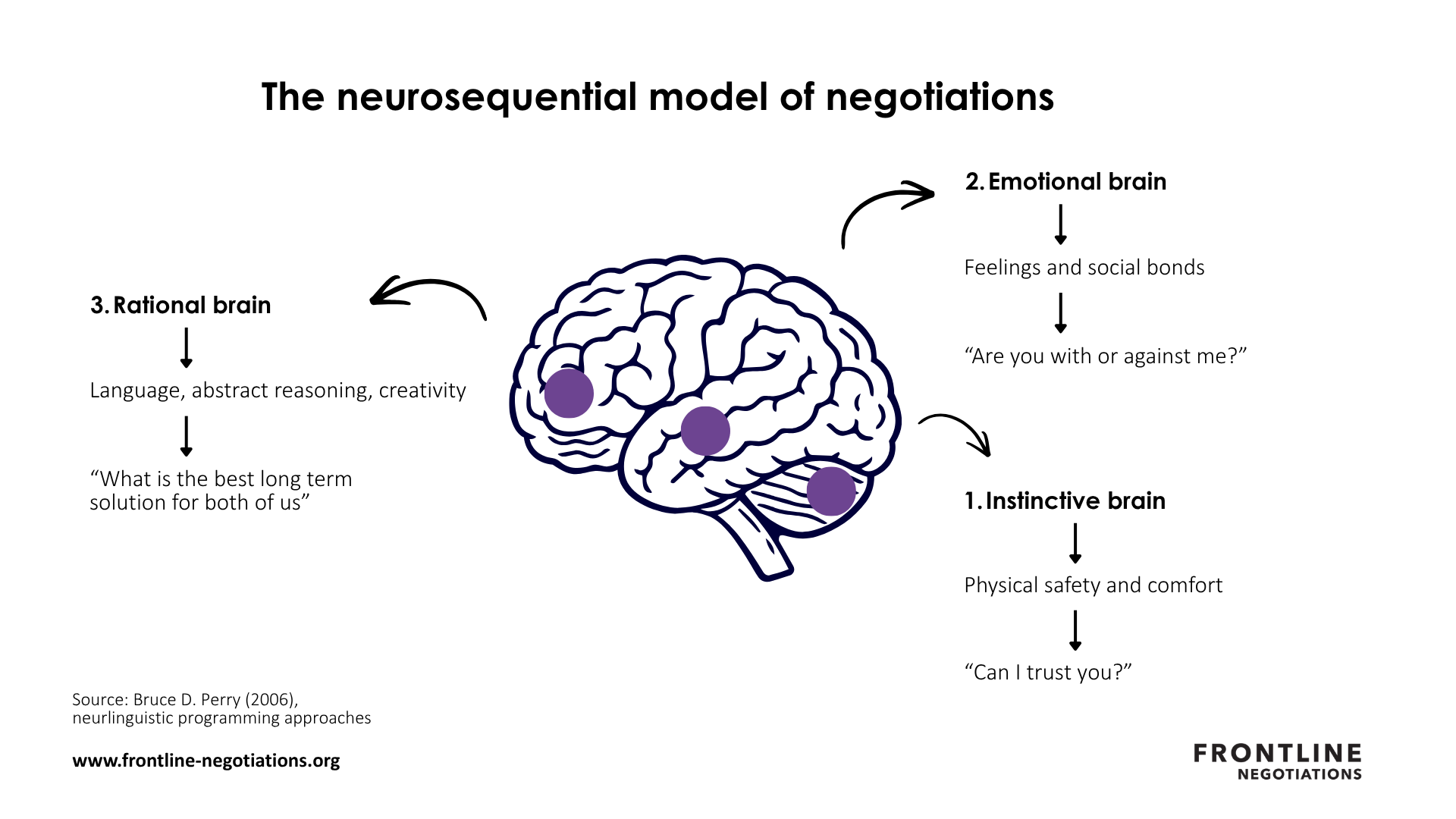
This progression moves from the inside out, starting with yourself, then extending to the person across the table, and ultimately shaping the broader dynamic of the negotiation. Each step corresponds to a different part of the brain, and each requires a distinct set of skills.
Step 1: Build trust (starting with yourself)
The foundation of any negotiation is trust – and it begins before you even speak the first word.
At this first level, the brain is operating in what Perry’s model calls the “reptilian” mode: basic, instinctual responses tied to a sense of physical safety. When someone feels unsafe, they become defensive. Trust is what moves them out of that state.
But here is something that is easy to overlook: before you can build trust with your counterpart, you need to trust yourself.
Your internal state shapes everything your counterpart perceives: your tone of voice, your posture, the pace of your speech, your breathing.
These non-verbal signals are picked up subconsciously, and they communicate volumes before you have said anything of substance.
Self-trust means developing confidence in your own judgement and the ability to manage your stress responses.
It means knowing your own values and what triggers you, and having strategies to stay regulated when things get difficult. Skills like stress management, self-validation, and handling failure are all part of this foundation.
Once you are grounded in yourself, you can focus on building trust outwardly.
This involves paying attention to legitimacy (are you perceived as credible and consistent?) as well as the signals you are sending through your body language, micro-expressions, and emotional presence. Emotional intelligence and emotional regulation are central here.
Try this: Body scan before you negotiate
Reflect
Before your next negotiation, take two minutes to check in with yourself. Ask:
- What am I feeling right now?
- Where am I holding tension?
- What is my stress level on a scale of one to ten?
Simply naming your internal state helps the brain shift out of reactive mode.
Technique
Regulate your breathing before you enter the room.
Inhale for four counts, hold for four, exhale for six.
This activates the parasympathetic nervous system, slows your heart rate, and restores access to your frontal lobes. Do it three to five times. Your body language will follow.
Step 2: Create a connection (from "you vs me" to "us")
Once a basic level of trust exists, you can move to the second stage: creating a genuine human connection with your counterpart.
This is where the limbic system – the part of the brain that processes emotions and social bonds – comes into play. Connection shifts the dynamic from adversarial to collaborative. It turns negotiation into problem-solving.
Creating a connection requires stepping outside your own perspective and genuinely understanding your counterpart’s emotions, values, cultural context, and motivations. This is not about performance or technique. It is about authentic human engagement.
The key skills here include empathy, active listening, and the ability to adapt your communication style to the person you are talking with.
Mirroring, subtly reflecting your counterpart’s language, tone, or body language, can help establish rapport.
Your voice itself is a powerful tool too: the pace, pitch, and warmth of how you speak send signals that either draw people in or push them away.
Importantly, connection also starts with self-awareness. You need to understand your own communication style, personality, and conflict-handling tendencies before you can truly attune to someone else.
Try this: Listen to understand, not to respond
Reflect
After a recent negotiation or difficult conversation, ask yourself honestly:
- Was I listening to understand, or was I listening while preparing my next point?
Under pressure, most of us default to the latter. Noticing this habit is the first step to changing it.
Technique
In your next conversation, practice the “last three words” method.
When your counterpart finishes speaking, briefly repeat the last two or three words they said as a gentle prompt, not a parrot impression.
This signals that you are genuinely present, encourages them to continue, and gives you a moment to absorb what was actually said before you respond.
Step 3: Exert influence (rational, creative, and strategic)
With trust and connection in place, you can influence your counterpart.
Influence at this level engages the cortical brain, responsible for language, logic, creativity, and abstract reasoning.
This is where strategic communication becomes possible: choosing your words carefully, using metaphors or stories to make ideas land, asking powerful questions, and managing expectations.
But here is the catch: if you are still in a defensive or protective mental state, the cortical brain is not fully online. That is why the sequence matters. You cannot skip straight to influence without first building trust and a connection.
Self-regulation, or the ability to intentionally shift your mental state, is what makes access to this level possible.
At the influence stage, you are also navigating the difference between genuine influence and manipulation.
Influence, in the CCHN’s framework, means engaging your counterpart’s rational mind transparently and through shared interests. It means adapting your message to what motivates them, not misleading them.
Try this: Reframe your message around their motivation
Reflect
Think about a negotiation where you felt your arguments were reasonable, but your counterpart simply was not moving. Ask yourself:
- Was I framing my message around my priorities or theirs?
Often, the issue is the angle, not the substance of the argument.
Technique
Before your next negotiation, write down the one thing you need your counterpart to agree to.
Then write down three reasons why that outcome would benefit them specifically – not you, not the mission in the abstract, but them, in their context, with their pressures and priorities. Use those reasons to shape how you present your position.
This simple reframe is one of the most effective tools for moving from persuasion to genuine influence.
The bigger picture: soft skills as a practice
What makes this framework valuable is not just the individual skills it identifies, but the logic of how they build on each other. Trust creates the conditions for connection. Connection creates the conditions for influence. Each step prepares the ground for the next.
This also means that soft skills are not something you either have or do not have. They are capacities that can be developed, trained, and strengthened over time, especially when you understand the neuroscience behind them.
By building greater awareness of your own internal processes and by practising the skills at each level, you progressively expand your ability to operate effectively even in the most challenging environments.
For humanitarian negotiators, this matters enormously.
The contexts you work in will stress-test every one of these capacities. The more you invest in developing them, the better equipped you are to build the trust that gets aid through, create the connections that open doors, and exercise the influence that saves lives.
Soft skills aren’t fixed traits; they’re capacities that you can strengthen with practice. Trust creates the conditions for connection, and connection creates the conditions for influence. Each step enables the next.
Good luck!
Want more negotiation tips? Explore our other posts.