The words you choose in a negotiation can either build bridges or create barriers. When you’re negotiating humanitarian access in volatile contexts or navigating high-stakes discussions with government authorities, every word matters.
In a recent CCHN webinar, Heather Cairns-Lee, Professor of Leadership and Communication at IMD Business School, introduced humanitarian negotiators to ‘clean language’, a deceptively simple communication method that helps you understand and connect with others more deeply without imposing your own assumptions.
The hidden assumptions shaping your negotiations
Think about the last difficult conversation you had. Did you really hear what the other person was saying, or were you listening through the filter of your own assumptions?
According to Cairns-Lee, assumptions are mental shortcuts that your brain uses constantly. They’re essential for functioning, but they’re also like an iceberg: most of them sit below the waterline, invisible to you. These hidden assumptions influence what you see, how you interpret situations, and ultimately, how you respond.
‘We see things as we are, not necessarily as the world is,’ Cairns-Lee explained.
The first step in using clean language is to notice your assumptions. As psychologist R.D. Laing wrote: ‘The range of what we think and do is limited by what we fail to notice. And because we fail to notice that we fail to notice, there is little we can do to change until we notice how failing to notice shapes our thoughts and deeds.’

What is clean language?
Clean language is a method for asking questions and listening with minimal imposition of your own interpretations or suggestions.
Developed by New Zealand counselling therapist David Grove, it’s based on four key principles:
- Asking clean questions.
- Paying attention to metaphor.
- Maintaining focused attention.
- Modelling the other person’s world.
The questions are simple because, as Grove said, ‘people are complex enough.’
Here’s how it works in practice:
During the webinar, a participant mentioned they negotiate ‘access‘ in their humanitarian work. Instead of assuming what kind of access, Cairns-Lee asked: ‘What kind of access is that access?’
This simple question, using the exact words the person used, invited them to clarify their meaning without the questioner imposing their own interpretation.
Why questions are your superpower
Questions do more than gather information. They:
- Build rapport by showing genuine curiosity,
- Create openness and trust when framed with the right words,
- Give space for others to express themselves,
- Help you check and validate your assumptions.
Clean language questions have a special quality: they acknowledge someone’s experience exactly as they describe it.
When you use someone’s precise words and add a simple, neutral question, you’re not dragging their experience onto your map of the world. You are trying to understand their world as they describe it.
The hidden power of metaphor
You might think metaphors are just fancy language devices, but research shows they are the foundation of how you think, especially about abstract, emotional or novel concepts.
On average, people use four to six metaphors per minute. That’s one metaphor for every 10 to 25 words. You’re probably not aware of most of them, but they’re quietly shaping how you understand and respond to situations.
In humanitarian negotiations, the metaphors you use matter just as much.
Are you framing the discussion as a battle to be won?
A bridge to be built?
A puzzle to be solved?
Cairns-Lee shared a striking research example (Thibodeau and Boroditsky, 2011) about how metaphors influence decision-making. Researchers described crime in a city using two different metaphors:
- Crime as a virus infecting the city
- Crime as a wild beast preying on the city
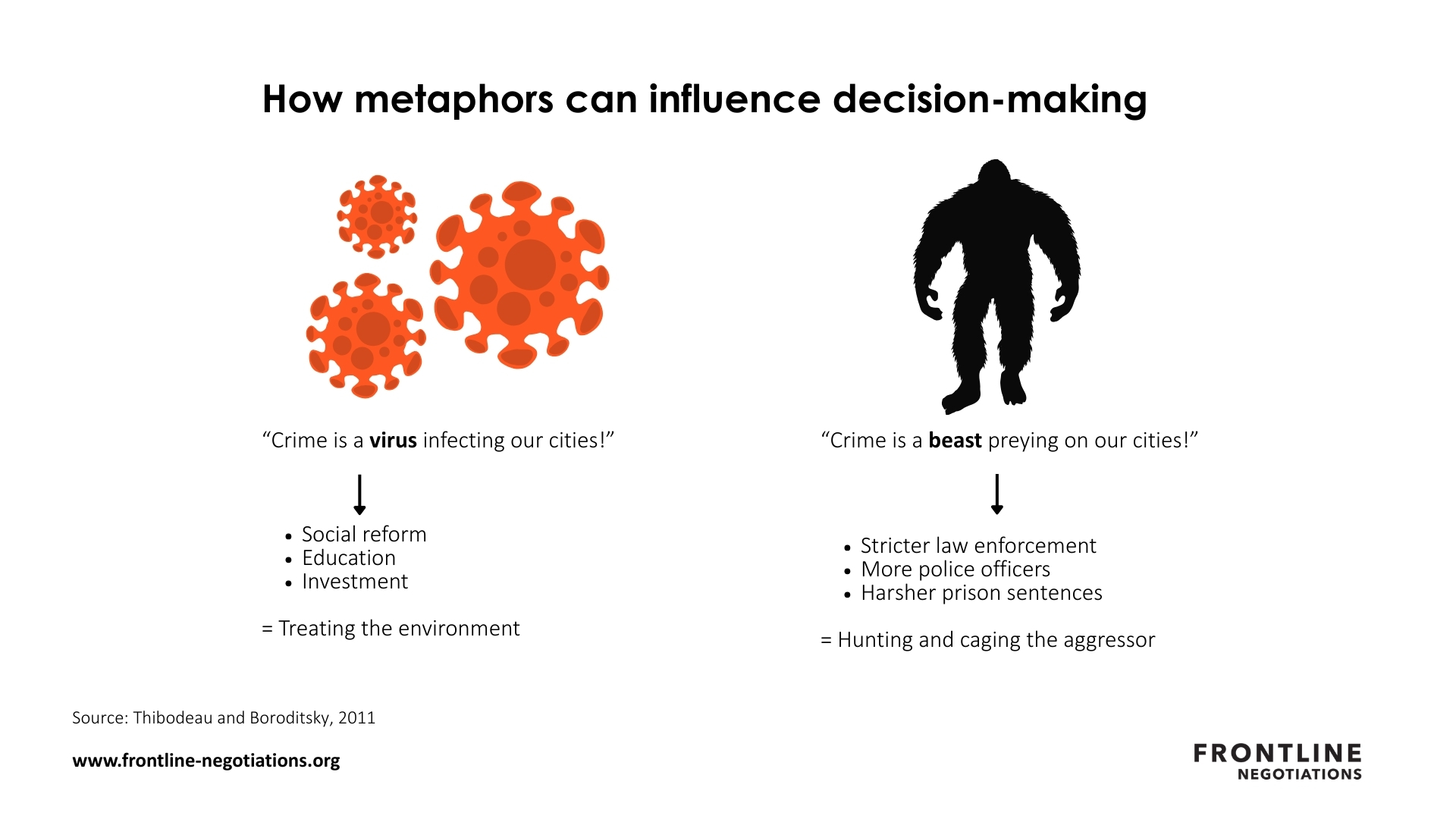
When crime was framed as a virus, people favoured solutions like social reform, education, and economic investment (treating the environment). When it was framed as a beast, people preferred stricter law enforcement, more police, and longer prison sentences (hunting and caging the aggressor).
The only thing that changed was the metaphor, but it altered how people thought about the problem and its solutions.
Once you start noticing assumptions and metaphors, clean language can give you practical tools to explore them.
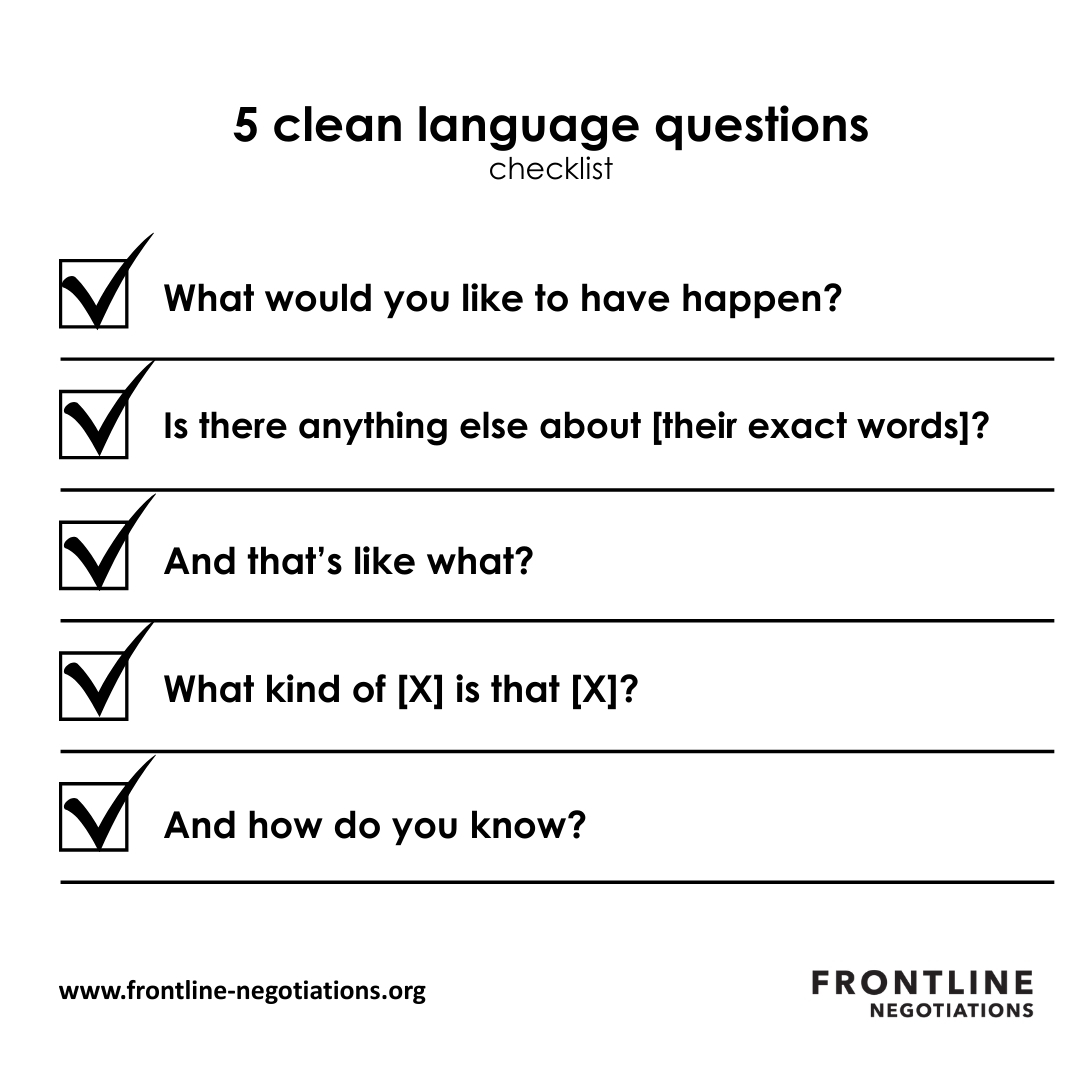
Five clean language questions to use tomorrow
Cairns-Lee shared five essential clean language questions you can start using immediately in your negotiations:
- ‘What would you like to have happen?’
This invites people to think about their desired outcome in a neutral way, without you suggesting what it should be.
- ‘Is there anything else about [their exact words]?’
This is perhaps the most powerful question. There is often more that people can share, and this question invited them to do so.
- ‘And that’s like what?’
This invites a metaphor, which can make difficult or abstract concepts easier to discuss.
- ‘What kind of [X] is that [X]?’
This helps you understand their specific meaning without assuming you already know.
- ‘And how do you know?’
The key to all these questions is using the person’s exact words. Don’t paraphrase. Do use their precise words with genuine curiosity.
The key to all these questions is using the person’s exact words. Don’t paraphrase. Do use their precise words with genuine curiosity.
Navigating power imbalances with clean language
One webinar participant asked how clean language helps when negotiating with actors who hold significantly more power, such as armed groups or government authorities.
Cairns-Lee explained that clean language helps equalise power dynamics because you focus on the language itself, not the person’s position. You’re having a conversation language-to-language, which brings the human dimension onto more equal footing.
When you pay exquisite attention to how someone expresses themselves and truly hear them in their own words, they feel acknowledged. This creates a sense of neutrality that can help powerful actors feel less need to push their agenda, making them more receptive to co-creating solutions.
The clean approach: exquisite listening
Clean language isn’t just about the questions you ask. It’s also about how you listen. Cairns-Lee calls this ‘exquisite listening.’
Instead of paraphrasing what someone says (which translates their words onto your map of the world), try repeating their exact words in a tone of genuine curiosity. This slows down the conversation and creates a powerful sense of being truly heard.
Sometimes, simply repeating someone’s words with ‘And…’ is enough to encourage them to continue sharing.
The clean language approach entails:
- Preserving other people’s experience as they express it
- Refraining from introducing your own judgements
- Inviting others to attend to their experience without trying to change it
- Only introducing words that don’t suggest new content
Understanding your negotiation metaphor
During the webinar, participants explored their own metaphors for negotiation. The responses revealed fascinating insights:
- A fierce lion bringing food to its cubs
- The calm but powerful August sea
- Water flowing and adapting to forces
- Dragging a boulder up a mountain
Each metaphor revealed something about how that person approaches negotiation.
The lion metaphor suggested fierce protection and provision. The sea metaphor contained both calm and power. The boulder metaphor highlighted the repetitive, effortful nature of some negotiations.
One participant noted that their metaphor (the lion) made them realise their approach might not be the most effective. This self-awareness is exactly what clean language can unlock.
Cairns-Lee suggested considering more collaborative metaphors: a bridge connecting perspectives, a dance requiring responsiveness and timing, a puzzle in which pieces need to fit together.
Compare these to combat metaphors like ‘negotiation is war’ or ‘playing your cards right,’ which suggest winners and losers rather than mutual solutions.
Practical steps to start using clean language
Here’s what you can do this week:
- Notice your assumptions
Start paying attention to the assumptions you make in conversations.
What are you taking for granted?
What are you assuming you understand without checking?
- Listen for metaphors
Notice the metaphors you and others use.
How are these metaphors framing the conversation?
Are they helping or hindering?
- Practice the five questions
Start using the five clean language questions in everyday conversations.
Try them at dinner with family or in team meetings before using them in high-stakes negotiations.
- Explore your own metaphor
Ask yourself: When I’m negotiating at my best, I’m like what?
Then explore that metaphor further. What kind of [X] is that? Is there anything else about it?
Consider drawing it to gain more insight.
- Use exact words
Instead of paraphrasing, practice repeating people’s exact words with genuine curiosity.
This takes practice, but is worthwhile because it creates a powerful sense of being heard.
Clean language in multilingual contexts
Humanitarian negotiators often work through translators or in multilingual settings. Clean language becomes even more valuable in these contexts, because metaphors are often culturally specific.
During the webinar, one participant described being like ‘the August sea,’ which meant calm and refreshing to someone from Greece but suggested flooding and uncontrolled emotion to someone from Sudan. This demonstrates why listening attentively and asking ‘What kind of sea is that?’ is so important.
When working with a translator, brief them on the clean language approach. Ask them to translate the speaker’s exact words and metaphors as literally as possible, rather than interpreting or paraphrasing. This helps you understand how the speaker actually thinks about the situation.
Supporting humanitarian principles through clean language
Clean language supports core humanitarian principles:
Neutrality:
By using the other person’s exact words without adding your own interpretations, you maintain a neutral stance.
Impartiality:
Clean language helps you understand all perspectives equally, without imposing judgement on whose needs matter more.
Independence:
By not introducing your own agenda through leading questions, you preserve the independence of the conversation.
The simplicity beneath complexity
David Grove, the founder of clean language, said:
‘The questions are simple because people are complex enough.’
You don’t need complicated techniques to have better conversations. You need to notice your assumptions, listen exquisitely, pay attention to metaphors, and ask simple questions using the other person’s exact words.
As Cairns-Lee emphasised, this takes practice. Clean language looks effortless, like a swan gliding across water, but there’s work happening beneath the surface.
The words you choose really do open doors, or close them. Choose wisely, listen deeply, and notice what changes.
Start small. Notice one assumption today. Try one clean language question this week. Listen for metaphor in your next negotiation.
Want more negotiation tips? Explore our other posts.