

You’re the mandator. You’ve tasked your field team to vacate a school occupied by armed actors.
But they’re up against a red line: your organisation prohibits speaking directly to armed groups.
Caught between these two parameters, how does your negotiator know how to do their job?
If you send your team into the field with a vague negotiation mandate and no clear red lines, you leave them exposed.
They have to rely on their judgement, intuition and personal experience, without knowing what they can compromise on.
And when pressure builds, they have no institutional backup.
So how do you make sure your negotiators know the limits of what they can do, and when to come back to you?
How do you stop them from making promises you can’t keep?
And how do you leave room for their judgement and experience, while still reaching people affected by crisis?
As a mandator, your job is to legitimise the negotiation while keeping it within your organisation’s policies and principles. A clear mandate helps you do both.
In this blog, you’ll learn how to design a negotiation mandate and set red lines that give your negotiators the confidence to act (plus, you’ll get a helpful template for your next negotiation).
What is a negotiation mandate?
A negotiation mandate can be defined as:
“The authority given to an individual or team by their organisation to negotiate and build trust with others. It allows them to explore solutions within a specific area and gives them legitimacy.”
In other words, there is no negotiator without a mandate.
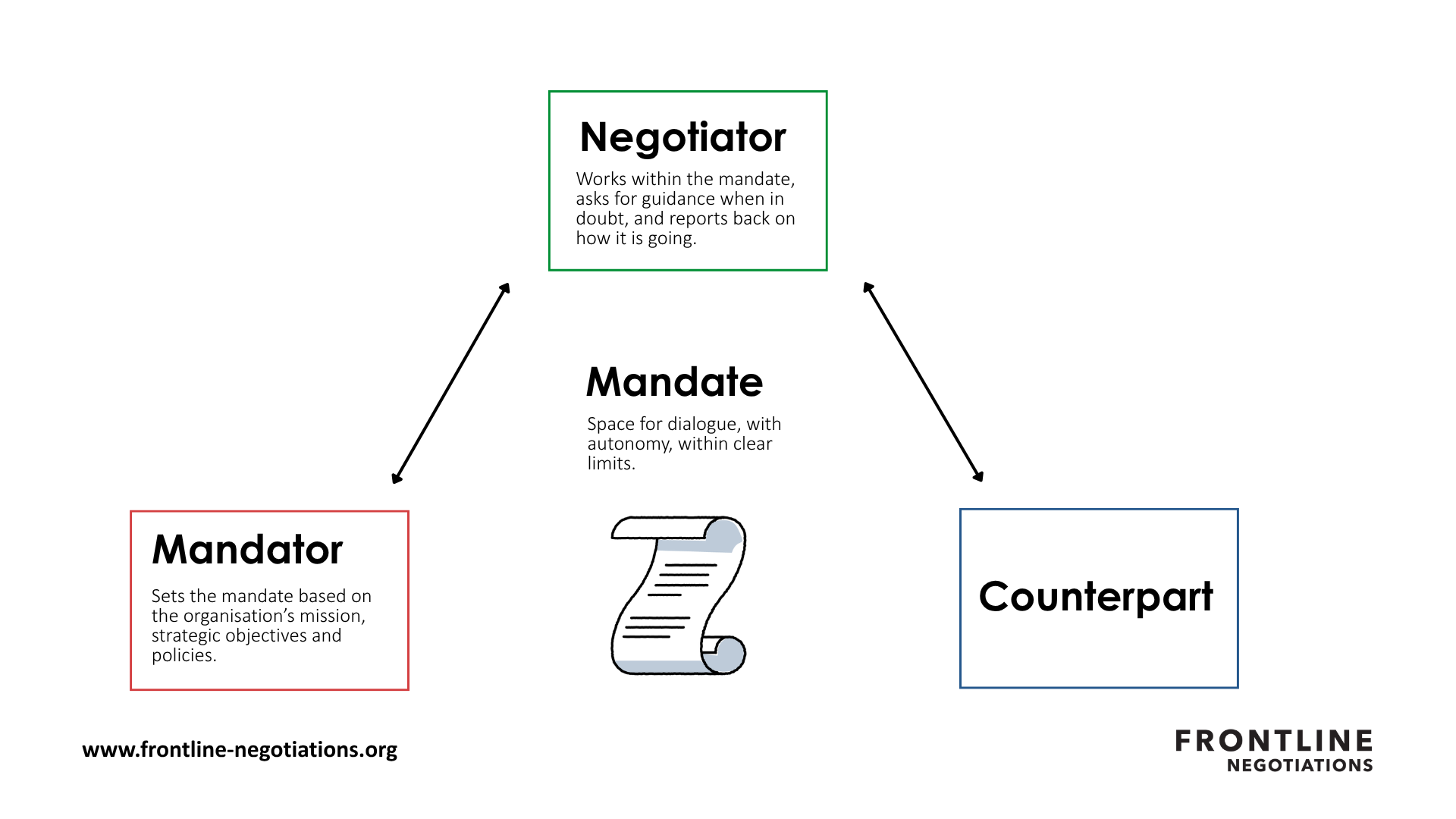
Who is responsible for setting a negotiation mandate?
The mandator (you) sets the mandate based on your organisation’s mission, strategic objectives and policies.
The negotiator (field team member) works within the mandate, asks for guidance when in doubt, and reports back on how it is going.
The aim of a negotiation mandate is simple: to give negotiators a space for dialogue, with autonomy, within clear limits.
The three building blocks of a negotiation mandate
A good mandate has three elements: operational objectives, red lines and role attribution.
Operational objectives describe what the negotiator should achieve, based on your organisation’s mission and strategic objectives.
Red lines set the boundaries within which the negotiator can negotiate. They are informed by institutional policies, legal frameworks and principles (more on the sources of red lines below).
Role attribution says who will lead the negotiation, who they report to, and how they will report on progress.
“Don’t ask, don’t tell” policies
Some organisations don’t require negotiators to report back to their hierarchy on compromises that go against institutional policies.
A “don’t ask, don’t tell” approach gives negotiators in the field the most flexibility. But it also carries significant reputational risks in an interconnected world.
Keeping arrangements secret also stops your teams from learning how to apply humanitarian principles in different contexts.
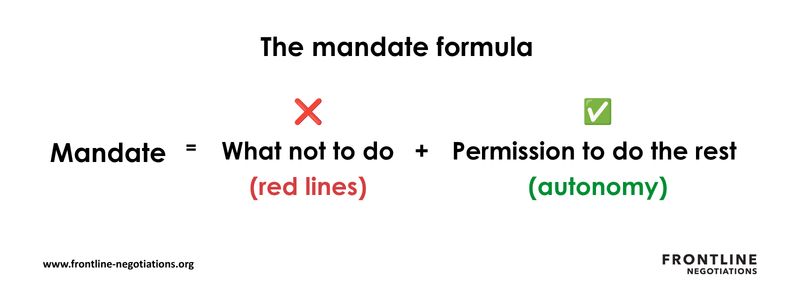
Why red lines are important
Red lines are enablers.
Just as a project’s scope defines what is in and out, a mandate’s red lines outline what a negotiator can and can’t do, and what they can compromise on.
When red lines aren’t clear, negotiators can become paralysed or, just as dangerous, too impulsive. When you clarify red lines and what they mean in practice, negotiators can make thoughtful, decisive decisions.
It also gives you, as team leader, a chance to flag risks field staff might not know about, such as donor policies or guidelines on speaking with actors under sanctions.
Knowing what is acceptable for your organisation helps negotiators build trust with the counterpart, too.
Some negotiators worry that being upfront about what they can compromise on will shut down the conversation. But when your counterpart knows where you stand and how much room you have to negotiate, it becomes easier to understand each other and reach a suitable agreement.
This doesn’t mean opening the negotiation with a rigid stance. It means communicating calmly and professionally about what is possible, so you don’t waste your counterpart’s time on options that aren’t realistic.
Clear internal red lines help you explain them better to your counterpart. Compare these two ways of explaining the same red line:
Less effective: “We cannot give you the list of people, because we are not allowed to.”
More effective: “We are unable to share the personal identifying information of our programme participants because we do not have their consent to do so. Informed consent is one of the main data protection principles that our organisation respects.”
Finally, clear red lines help negotiators avoid agreeing to things their organisation can’t support, and then having to back out, which puts the trust they have built at risk.
How to set red lines in a negotiation mandate
Red lines come from several sources:
- Legal frameworks
- Institutional policies
- Humanitarian principles
- Professional standards and procedures
- Moral and ethical boundaries
When you outline them in your mandate, translate them into practice.
In other words, connect each red line to specific, observable behaviours.
Take “programming in the presence of armed actors and direct engagement with them is forbidden.”
What does that mean in practice?
- Can a negotiator engage with armed actors indirectly, for example, through community leaders?
- If so, what forms of dialogue through intermediaries are acceptable?
- How can the risks of using intermediaries be reduced?
Red lines should always be the mandator’s call, never the negotiator’s. This protects field staff from counterparts who might push for compromises beyond the red lines if they believe the negotiator can overrule them.
When the final call rests with you, negotiators can buy time by saying they need to consult their manager before agreeing to a particular arrangement.
Why you shouldn’t assume your team is aligned on humanitarian principles
Humanitarian principles are a fundamental source of red lines.
But putting humanitarian principles into practice is a relative, context-dependent process.
And it can be even more difficult when it shapes resource allocation, negotiating behaviour and risk tolerance, especially when they clash with your organisation’s funding or growth.
When a principled decision has financial or reputational costs, what happens next depends on whether your institution backs it, or leaves individual staff to carry it alone.
CCHN research identified two out of four types of organisations that can leave field teams carrying the operational weight of principled decisions:
- Stratified organisations split authority and practice. Field staff carry the operational weight of principled action, while headquarters operates on a different logic. This allows for adapting to the context, but negotiators can end up making commitments headquarters isn’t ready to back. Unclear escalation routes then push problem-solving onto the people with the least institutional support.
- Transactional organisations keep their principles but use them as a tool: they invoke them when useful and set them aside when they create friction. This can look effective in the short term. But sophisticated counterparts quickly notice when principles are negotiable, and they apply pressure at exactly those points.
Staff interpret and apply humanitarian principles differently depending on their role, how close they are to operations, the political context and their organisation’s culture.
💡 Organisations that invest in structured answers, such as tiered decision-making, clear escalation pathways and context-specific guidance, tend to hold together better under pressure than those that rely on individual judgement in the moment.
That’s why it’s worth testing, rather than assuming, that your team shares your understanding of the principles.
How to write a negotiation mandate
Now it’s your turn to build a negotiation mandate. Here’s an example to work from:
|
Mandate |
|
| Mission/organisational mandate | Ensure that the world’s most vulnerable children survive, learn and are protected. |
| Strategic objectives |
|
| Operational objective(s) | Restore a safe and protective learning environment for approximately 1,000 displaced children and children from the host community by vacating a school occupied by armed actors |
| Red lines Relevant institutional policies, legal limitations, principles, professional procedures and ethical boundaries translated into specific, observable behaviour. |
What isn’t allowed:
What is allowed:
What to check with the mandator:
|
|
Role attribution |
|
| Lead negotiator | Programme Officer |
| Reports to | Regional office director |
| Reporting | [Format, timing and contents] |
| Communication channel | Instant messaging app Phone call |
Download the negotiation mandate template (PDF) to create your own.
Remember…
The clearer the mandate, the stronger your negotiator’s leverage and the trust they can build with counterparts.
A solid mandate helps you balance operational objectives with respect for principles and organisational policies.
It protects your organisation’s reputation, builds trust with counterparts and strengthens relationships with communities.
Clarity helps everyone. It also keeps you and your team accountable to one another, to your organisation and to the people you assist.
Want more negotiation tips? Explore our other posts.